Opened On, Frozen On, Defrost: getting back-of-house date labelling right
Written by Tara Beattie, co-founder of Prepsheets, drawing on 25+ years running hospitality businesses in Ireland.
Back-of-house date labels – Opened On, Frozen On, Defrost – exist to answer one question at a glance: is this still safe to use? They're not the customer-facing allergen or nutrition labels required by law on packaged and prepared food; they're the internal control that makes your HACCP-based food safety system actually work day to day, by tracking exactly when something left its original packaging, went into the freezer, or came back out of it. Get the dates wrong, or lose them entirely when food gets decanted, and everything downstream – shelf life, allergen tracking, traceability – breaks with them.
The three labels, and what each one controls
| Label | What it marks | Typical shelf life | What breaks without it |
|---|---|---|---|
| Opened On | The date a sealed ingredient or product was opened | Often 2–3 days for high-risk items, set per product | No way to know how long something's been open; food gets used past safe limits or binned early "just in case" |
| Frozen On | The date an item went into the freezer | Commonly up to 30 days, depending on the product | Freezer stock can't be rotated properly (first in, first out), and frozen product can't be distinguished from fresh |
| Defrost | The date an item was pulled from frozen and its use-by once thawed | Usually 2–3 days once defrosted | Defrosted food gets refrozen or held too long, both of which are food safety risks |
These aren't arbitrary categories, and they aren't a UK-and-Ireland quirk either. Once food is opened, prepared, frozen, defrosted or repackaged, it falls outside its original manufacturer date coding and into your own kitchen's date labelling system. HACCP – the hazard analysis and critical control point framework behind almost every national food safety code – comes from Codex Alimentarius, the joint FAO/WHO standard used as the baseline by well over 180 countries. Under Regulation (EC) No 852/2004 (retained in UK law post-Brexit, and the basis for Ireland's food safety regulations), every EU and UK food business is required to run a documented food safety management system based on HACCP principles, and date labelling of prepared and stored food is a core, checkable part of that system, not an optional add-on. In the US, the same underlying logic shows up as the FDA Food Code's "seven-day rule" (§3-501.17): ready-to-eat food held under refrigeration has to be date-marked and used or discarded within 7 days, with freezing pausing that clock rather than resetting it. Different rulebook, same principle – if a kitchen can't show at a glance how old something is, it can't show the food is safe.
Ireland's labelling rules go further for frozen product specifically, as one example of a national rule sitting on top of that Codex/HACCP baseline: frozen meat, meat preparations and unprocessed fishery products must carry the words "Frozen on…" with the actual date, and once something has been frozen and defrosted, it can't be sold or presented as "fresh" again. That's a labelling requirement for pre-packed frozen product rather than an internal kitchen label, but the same logic is exactly why a Frozen On label matters behind the pass, wherever you're operating: if you can't see when something went into the freezer, you can't honestly say what state it's in.
Where this goes wrong in practice
A few patterns show up again and again in kitchens running paper or handwritten labels:
- The label doesn't travel with the food. An ingredient comes out of its packaging into a fridge tub or freezer bag, and the date – and its allergen information – doesn't go with it. By the time it's used again, whoever's cooking has nothing written down to check against.
- Handwriting is illegible or gets skipped under pressure. A busy service is exactly when labelling gets rushed or missed, which is also exactly when a mistake is most likely to matter.
- Frozen and defrosted get mixed up. Without a clear, consistent system, it's easy to lose track of what's been refrozen, which is both a quality and a safety issue.
- Allergens don't carry over. A generic "Frozen On" sticker with just a date tells you nothing about what's actually in the bag if the packaging it came from is long gone.
Getting this right at the recipe level
This is where back-of-house labels and the customer-facing ones (PPDS packaging, counter and display labels) should really be pulling from the same source, not two separate systems. In Prepsheets, every ingredient is set up once with the allergens it contains and the allergens it may contain, and every recipe built from that ingredient – including recipes nested inside other recipes – reflects it automatically. That same ingredient-level data is what populates the Opened On, Frozen On and Defrost labels, so the allergen and "contains"/"may contain" information on a back-of-house label is never separately typed up or allowed to drift from what's on the customer-facing one.
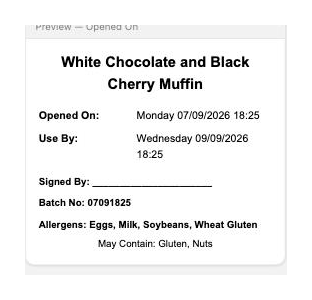
Shelf life itself is configurable per recipe – Opened On/Prep On, Frozen and Defrost shelf life are each set in days against the recipe, so the use-by time on the label calculates itself from the moment the label is printed rather than being worked out by hand each time. Every label also carries a batch number and a signed-by line, so there's an accountable record of who opened, froze or pulled an item, not just when.
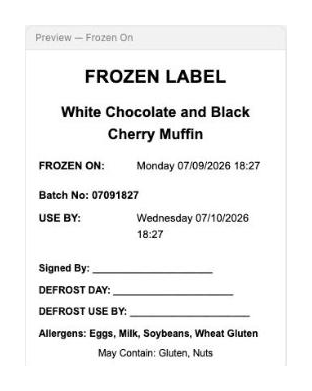
The Frozen label goes a step further and carries blank Defrost Day and Defrost Use By fields printed directly onto it, so the moment that item is pulled from the freezer, its next shelf-life window is already on the label rather than needing a second one worked out from scratch.
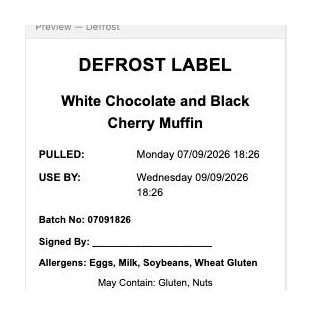
Evidence ready when an inspector asks for it
Labels only tell part of the story – an inspector who asks why a shelf life is set at 3 days rather than 5, or wants to see the spec behind an ingredient, needs something to back it up. Prepsheets lets you attach shelf-life testing documentation directly to a recipe and product specification sheets directly to an ingredient, stored in the same place as the costing and allergen data rather than in a filing cabinet, a shared drive folder nobody can find, or a former employee's laptop. Because it's cloud-based, it's accessible from any device on-site, so whether you're dealing with an environmental health officer in Ireland or the UK, a local authority inspector carrying out an official control elsewhere in the EU, or a health department inspector in the US, the paperwork behind a shelf-life decision or a supplier spec is pulled up on the spot rather than chased down after the visit.
Printing to any system
Labels generate as a live preview and export to PDF, so they print on whatever you're already using – a standard office printer and label stock, a dedicated label printer, or a print run sent to a third-party supplier – rather than locking you into one proprietary label printer or format. If your kitchen has a label size or layout that doesn't match the standard set (a particular container shape, a house style, a size your printer needs), Prepsheets also offers bespoke label design on request, built around the same underlying ingredient and allergen data rather than as a one-off static design that falls out of date the moment a recipe changes.
The short version
Opened On, Frozen On and Defrost labels are the internal half of food safety labelling – required in principle by the same Codex-derived, HACCP-based food safety management system that governs commercial kitchens in the EU, the UK, Ireland, the US and most of the rest of the world, and only as reliable as the process behind them. Handwritten or generic labels break down exactly where it matters: when food is decanted, when a kitchen is busy, or when nobody remembers to carry the allergen information across. Generating them from the same ingredient-level data as your customer-facing labels means the two can never quietly disagree with each other, and shelf life, batch tracking and allergens all come out of the box rather than being rebuilt by hand on every label – with the testing and spec paperwork behind them stored alongside, ready for whoever asks to see it.
Sources: FSA Guidance – Use By Dates; Forkto – Date Labelling in Commercial Kitchens UK; GOV.UK – Bulk Freezing of Ambient and Chilled Foods; FSAI – Labelling Requirements and Shelf Life; FSAI – Traceability FAQ; Regulation (EC) No 852/2004; FDA Food Code §3-501.17; FDA HACCP Principles & Application Guidelines; FoodDocs – Codex Alimentarius Commission & HACCP Guidelines