What are the 14 allergens I legally have to declare? (EU/UK)
Under UK and EU food law, you must be able to declare 14 allergens whenever they're used as ingredients: celery, cereals containing gluten, crustaceans, eggs, fish, lupin, milk, molluscs, mustard, peanuts, sesame, soybeans, sulphur dioxide/sulphites, and tree nuts. This applies to every food business that prepares, handles or sells food, not just packaged products, and it covers loose, counter and menu items as well as pre-packed ones. Here's what the law actually requires and where kitchens get caught out.
The 14 allergens, in full
| # | Allergen | Common sources |
|---|---|---|
| 1 | Celery | Celery stalks, leaves, seeds, celeriac, stock cubes |
| 2 | Cereals containing gluten | Wheat, rye, barley, oats, spelt, kamut |
| 3 | Crustaceans | Prawns, crab, lobster, crayfish, shrimp paste |
| 4 | Eggs | Whole egg, mayonnaise, meringue, some pasta and glazes |
| 5 | Fish | Fish, fish sauce, Worcestershire sauce, stock |
| 6 | Lupin | Lupin flour and seeds, used in some breads and pastries |
| 7 | Milk | Milk, cream, butter, cheese, yoghurt, whey powder |
| 8 | Molluscs | Mussels, oysters, squid, snails, whelks |
| 9 | Mustard | Mustard seed, powder, and prepared mustard/sauces |
| 10 | Peanuts | Peanuts, peanut oil, peanut flour, satay sauce |
| 11 | Sesame | Sesame seeds, tahini, sesame oil, hummus |
| 12 | Soybeans | Soy sauce, tofu, edamame, many processed sauces |
| 13 | Sulphur dioxide/sulphites | Above 10mg/kg or 10mg/L – dried fruit, wine, some sausages |
| 14 | Tree nuts | Almonds, hazelnuts, walnuts, cashews, pistachios, Brazil nuts, pecans, macadamia |
This list comes from Annex II of EU Regulation No 1169/2011 on Food Information to Consumers, which the UK retained after Brexit and enforces through the Food Information Regulations 2014. The Food Standards Agency (FSA) oversees compliance in England, Wales and Northern Ireland; Food Standards Scotland does the same north of the border. The list and the obligations are effectively identical across the UK and EU, so a menu built to this standard works on either side of the Channel.
Ireland goes a step further than the category names in that table. The Food Safety Authority of Ireland (FSAI) requires the specific cereal or nut to be named and highlighted, not just the umbrella term: "wheat", not "gluten"; "almond", not "nuts". It's a distinction environmental health officers check for directly – we had one tell us in person that "cereals containing gluten" on a label wasn't good enough on its own; she wanted to know which cereal. The same applies to tree nuts. Prepsheets identifies ingredients down to that level, so a recipe shows exactly which of the regulated cereals and which of the regulated nuts it contains, not just the category.
Why the rules cover loose food too – Natasha's Law, and Ireland's own rules
Before October 2021, foods made and packed on the same UK premises before being ordered – a sandwich made that morning and put in the chiller, for example – only needed allergen information available on request, not written on the pack. That changed with Natasha's Law (the Food Information (Amendment) (England) Regulations 2019, in force from 1 October 2021 in the UK), introduced after 15-year-old Natasha Ednan-Laperouse tragically died from an allergic reaction to undeclared sesame in a Pret a Manger baguette. It created a new category called PPDS – Prepacked for Direct Sale – covering any food packed on-site before a customer orders it. PPDS food now needs a full ingredients list on the label, with the 14 allergens emphasised (commonly bold, but any clear method of emphasis is accepted). Natasha's Law is UK-specific – it doesn't apply outside the UK.
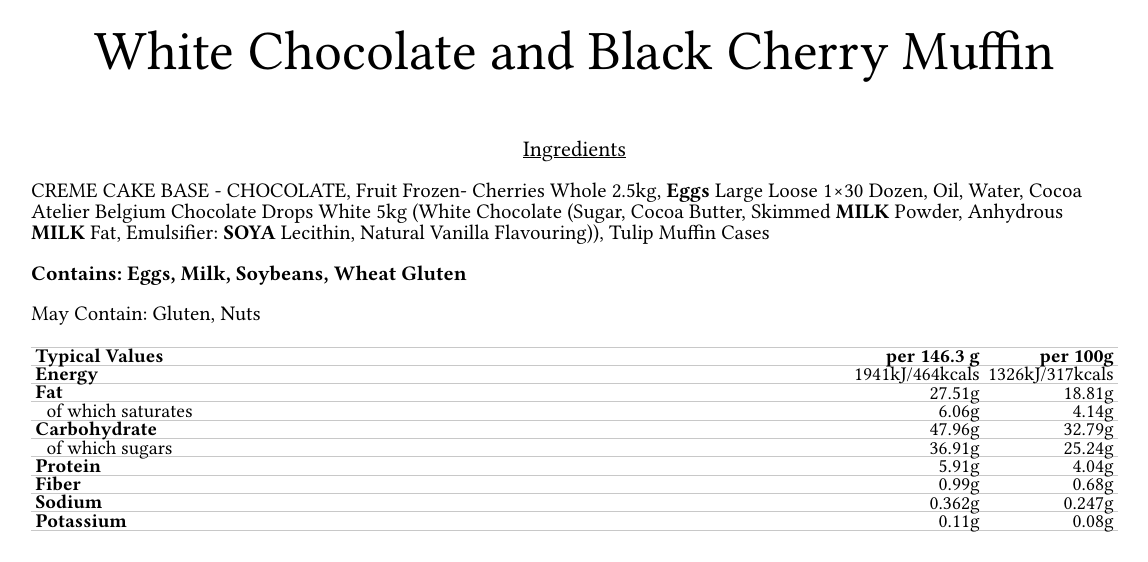
Food that isn't prepacked in the UK – a dish plated to order, or a sandwich made in front of the customer – still only requires allergen information to be available, which can be verbal, provided staff genuinely know the answer and can give it consistently. In practice this is where most kitchens are weakest: the label is easy to get right once; a server correctly answering an allergen question at 9pm on a busy Friday, every time, for all recipes, is harder.
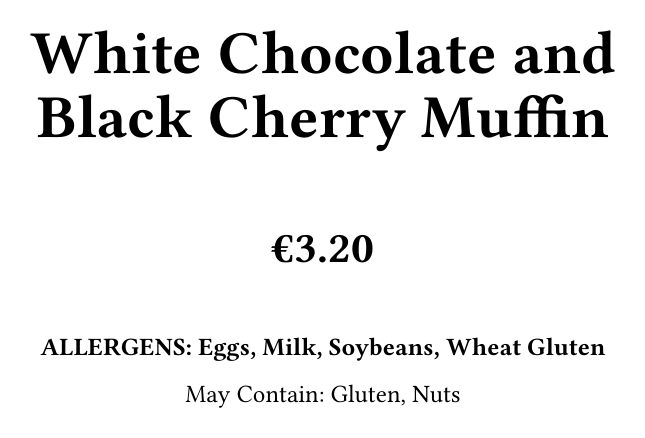
Ireland's rule for non-prepacked food is stricter than that by default. Under the Health (Provision of Food Allergen Information to Consumers in respect of Non-Prepacked Food) Regulations 2014 (S.I. No. 489 of 2014), enforced by the FSAI, written particulars of any of the 14 allergens must be available at the point of presentation or point of sale as standard – verbal information is only meant to supplement the written particulars in specific circumstances, not replace them as the default. A sandwich made to order in an Irish café needs written allergen information at the point of sale, not just "ask a member of staff." This is also where a customer-facing use for recipe software helps beyond the kitchen: Prepsheets can turn a costed, allergen-inclusive recipe straight into a priced product – a menu or price list a customer actually sees – so the written allergen information front of house hands out is pulled from the same record the kitchen works from, not typed up separately or handwritten and left to go stale.
What non-compliance actually costs
The human cost is the reason this law exists, and it isn't only about the fines – it's the aftermath for everyone involved when it goes wrong. Around 2.4 million UK adults – roughly 6% of the adult population – live with a clinically confirmed food allergy, and 5–8% of UK children have one. In Ireland, food allergy affects an estimated 2% of adults and around 4–5% of children, broadly consistent with the rest of Europe: EFSA estimates clinically confirmed food allergy at around 1–3% of the European population overall, though self-reported rates run much higher, around 20%. Hospital admissions for food-induced anaphylaxis in UK children roughly tripled between 1998 and 2018. Around 10 people die from food-triggered anaphylaxis in the UK each year, and peanuts and tree nuts account for the majority of fatal and near-fatal reactions. Those numbers are the backdrop every time an allergen question gets waved off at the pass, in any of these markets.
On top of that human cost – and everything that comes with living with it – there's a financial and legal one too. This isn't a low-stakes area of food law. Providing inaccurate or missing allergen information is a criminal offence under the Food Information Regulations 2014 in the UK, and fines are uncapped in the most serious cases. Where an allergen failure has caused a death, UK operators have faced manslaughter charges and custodial sentences – as happened following Natasha Ednan-Laperouse's death and other UK cases since. In Ireland, the FSAI has equivalent prosecuting powers under the Food Safety Authority of Ireland Act 1998, and can prosecute a food business for allergen breaches under the 2014 regulations; the highest-profile fatal cases so far have been in the UK, but the legal exposure – prosecution, unlimited fines, personal liability for a business owner – is the same on both sides of the Irish Sea.
Where kitchens actually go wrong
A few patterns show up repeatedly in enforcement cases and audits:
- Recipe changes don't get reflected in the allergen info. A supplier substitutes an ingredient, or a chef adds a dash of soy sauce to a base recipe, and the allergen list on the menu or system doesn't get updated to match.
- Sub-recipes hide allergens. A dish might not directly contain nuts, but a stock, dressing or sauce used inside it does. If allergens aren't tracked at ingredient level and rolled up through every recipe that uses it, this is very easy to miss.
- "May contain" gets used as a substitute for proper declaration, rather than as an honest precautionary statement about genuine cross-contamination risk – and it's often only recorded at the finished-recipe level, rather than rolled up from every sub-recipe and ingredient underneath it, which is exactly where it tends to fall down.
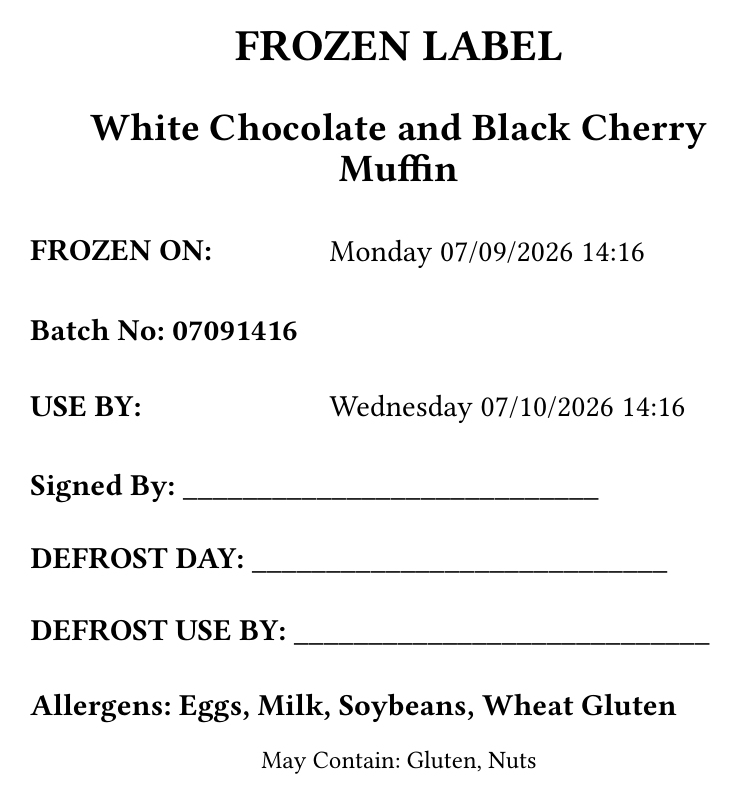
- Storage and decanting break the paper trail. An ingredient comes out of its original packaging into a fridge tub or freezer bag, and the allergen information doesn't travel with it. By the time it's used again, whoever's cooking has nothing written down to check against.
- Staff turnover outpaces training. Verbal allergen information is only as reliable as the person giving it, and hospitality has some of the highest staff turnover of any sector.
Getting this right at the recipe level
Allergen compliance starts at the same place recipe costing does: the ingredient. If every ingredient is highlighted with the allergens it contains and the allergens it may contain, for cross-contamination risk, then in Prepsheets every recipe built from that ingredient – including your sub-recipes – shows anybody looking at it exactly what allergens are contained or may be contained within it. An allergen list that's accurate today stays accurate when a supplier or a recipe changes, instead of relying on someone remembering to update it by hand: swap an ingredient, and whatever it contains or may contain updates on every recipe that uses it straight away. That's also how How do I cost a recipe? A step-by-step guide for professional kitchens recommends treating sub-recipes for costing, and the same structure solves both problems at once.
Our free recipe costing Excel template includes basic allergen tracking alongside the costing formulas, which is enough for a small, stable menu. It's manual, though: every ingredient swap means checking and updating allergens by hand across every recipe that uses it, and it doesn't handle "may contain" at all – exactly the kind of maintenance that breaks down as a menu grows.
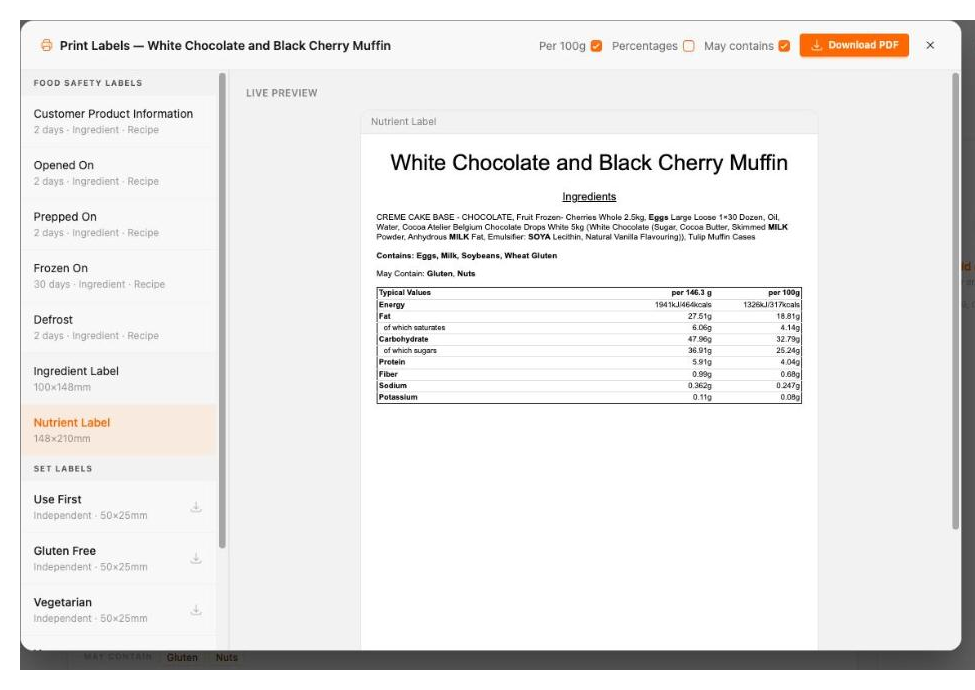
Prepsheets tracks both "contains" and "may contain" at ingredient level, right down to the specific cereal or nut rather than the generic category, and every recipe built from that ingredient – including recipes nested inside other recipes – reflects it automatically. Below is what that looks like in practice: every label type a recipe can generate, including the allergen-highlighted ones, with a live preview before printing.
The short version
The 14 allergens are a fixed legal list under both UK and EU law. They apply to loose and counter food as well as packaged goods, and PPDS items in the UK – or non-prepacked food in Ireland – need allergen information written down, not just available on request. Getting it right consistently is less about knowing the list – most kitchens do – and more about treating allergen information attached to ingredients, sub-recipes and recipes as a living document, so it updates itself the moment something changes instead of waiting for someone to remember.